From Gaelic Fields to NFL Dreams: Exploring Ireland's Athletic Crossover
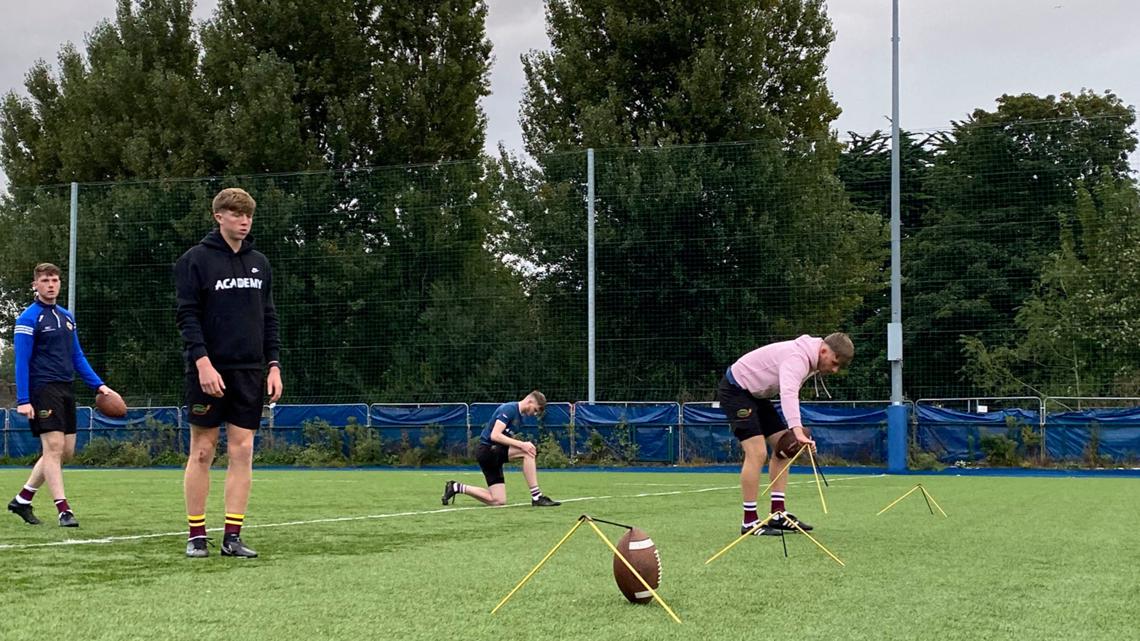
Ireland's traditional sports, known as Gaelic games, include Gaelic football, which showcases kicking skills that can be beneficial for American football, particularly in placekicking and punting. An increasing number of Gaelic football players are exploring opportunities in American football through college programs or the NFL's international player pathway program. As the Minnesota Vikings prepare to play the Pittsburgh Steelers at Croke Park in Ireland's first regular-season NFL game, let's delve into some insights about Gaelic games and the athletes aiming for the NFL.
Gaelic football, hurling, and camogie (women's hurling) are the most popular Gaelic games, played on rectangular fields with goals and goal posts similar to American football uprights. Scoring in the goal earns three points, while kicking through the uprights is worth one point. Gaelic football recently introduced a 2-point score for specific field kicks.
Gaelic football resembles rugby in terms of physicality but differs in ball movement rules. Players can carry and advance the ball but must bounce or kick it every four steps. They can pass to teammates through kicking or hand passing. Scoring involves kicking the ball into the net or through the uprights, with free kicks awarded for fouls, akin to soccer. The ball used is slightly smaller than a soccer ball.
Hurling and camogie combine elements of lacrosse, field hockey, and baseball, with players wearing helmets and face masks. The sliotar is the ball used, and the wooden stick is called a hurley. The Gaelic Athletic Association describes hurling as one of the oldest field games globally, dating back to 1272 BC.
The Irish government highlights the significance of Gaelic games in Irish culture, with Croke Park being a central hub for these sports. Gaelic games have also made appearances in popular culture, with Irish actor Paul Mescal popularizing GAA shorts.
The Gaelic Athletic Association, established in 1884 during a revival of Irish nationalism, oversees numerous local clubs promoting Gaelic football, hurling, handball, and rounders. While Gaelic games are amateur sports, players do not receive salaries, and many have other jobs or are university students. Inter-county competitions culminate in the All-Ireland finals each summer, attracting national attention.
Several Gaelic footballers are pursuing NFL opportunities as kickers, with players like Jude McAtamney, Charlie Smyth, and Mark McNamee making strides in the NFL. The trend of Irish kickers and punters extends to college football, with players like Sean O'Haire, Adam-McCann Gibbs, Andy Quinn, and David Shanahan showcasing their skills.
The transferable foot skills from Gaelic games, soccer, and rugby have contributed to the success of Irish athletes in American football. Notable figures like England soccer star Jack Grealish, who played Gaelic football in his youth, have acknowledged the impact of Gaelic games on their athletic development. With a wealth of Gaelic football talent emerging, the potential for Irish athletes in American football continues to grow.
In conclusion, the crossover between Gaelic games and American football presents exciting opportunities for athletes to showcase their skills on a global stage, bridging the gap between traditional Irish sports and the NFL.