Navigating the Future of Redistricting: Implications of the Recent Supreme Court Ruling
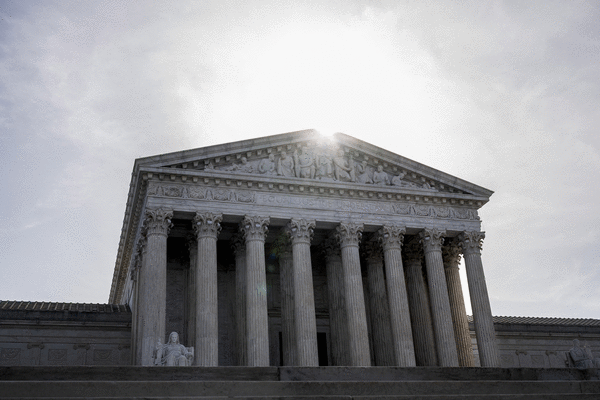
The recent Supreme Court ruling, with a 6-3 decision, invalidated Louisiana's newly established majority-Black congressional district, impacting the interpretation of Section 2 of the Voting Rights Act of 1965. This decision has broader implications for the nation's understanding of representation, race, and the future of redistricting. Section 2 aimed to ensure minority voters' equal opportunity to elect their preferred candidates, often leading to the creation of majority-minority districts. However, the court's ruling now places stricter limits on considering race in redistricting, emphasizing traditional districting principles like compactness and contiguity over explicit racial targets. This shift reflects a growing skepticism towards race-conscious remedies and highlights the need to prioritize constitutional principles in redistricting processes. The dissenting opinion raises concerns about the potential dilution of minority voters' influence if cohesive minority communities are not adequately represented in districts. This tension between colorblind principles and racial voting patterns underscores the complexity of balancing fairness and equality in redistricting. The ruling's immediate implications extend beyond Louisiana to other states, requiring legislatures and mapmakers to reassess their redistricting approaches. The heightened legal threshold for creating majority-minority districts increases the risk of litigation and may lead to challenges, redrawings, or eliminations of districts nationwide. The decision could subtly alter congressional representation, particularly in states with concentrated but politically fragmented minority populations, sparking debates on representation fairness and the alignment of maps with voters' preferences. As the nation navigates this pivotal moment, the challenge lies in reconciling the foundational principle of equal voting weight with the need for fairness in practice. It is crucial to ensure that redistricting processes neither perpetuate racial divisions nor disregard the historical marginalization of communities' political voices. With the court's decision delivered, the onus now falls on lawmakers, advocates, and citizens to navigate the post-ruling landscape with a commitment to justice, democratic integrity, and lawful practices.